
Being a good parent, not according to a list in a magazine, or vague memories of what grandparents might have thought or said, but being a good parent in the eyes of one's children, in one's examined soul, is a big thing most parents never even see a glimpse of.
We can go beyond normal.
|
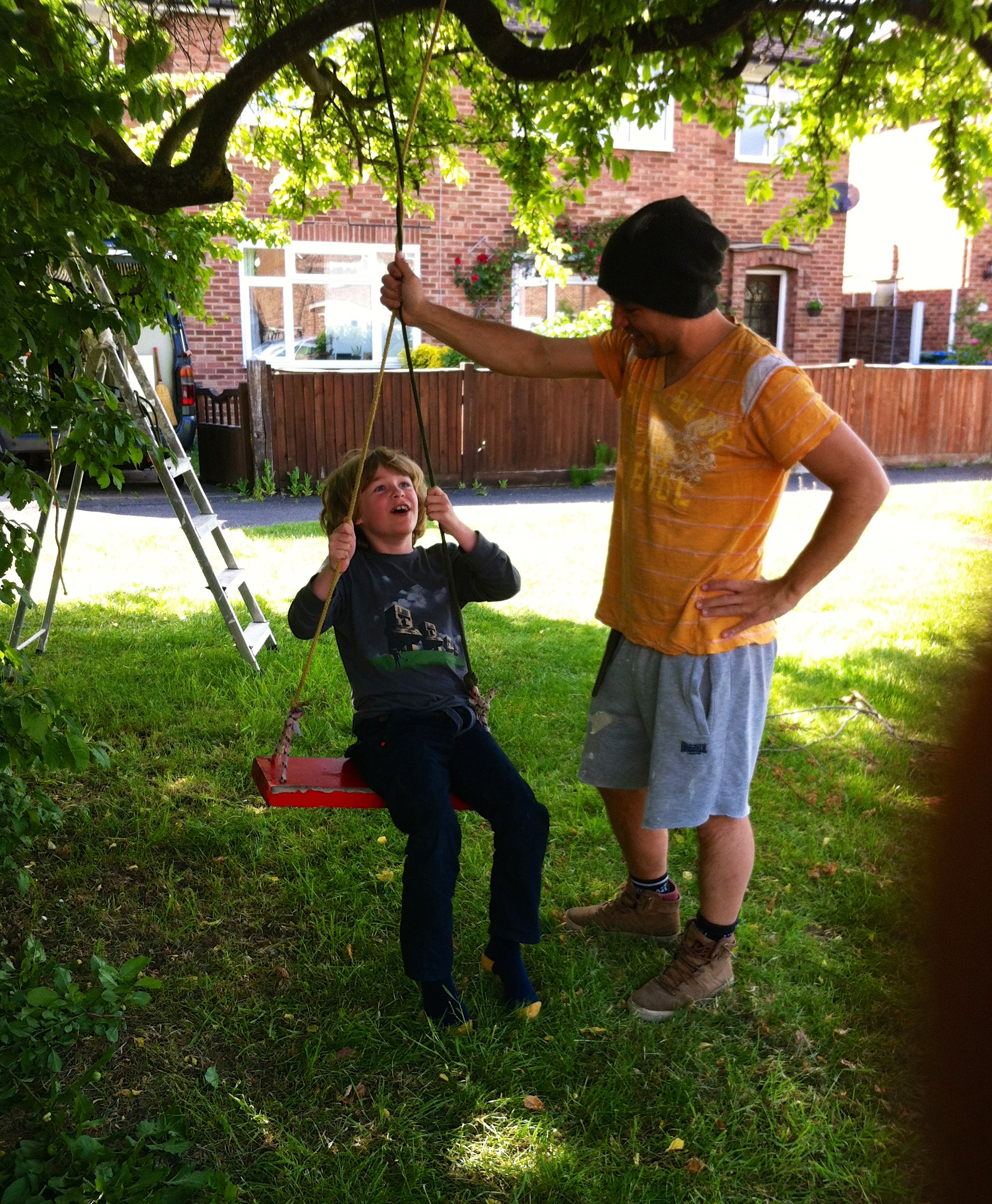
"I want to be the most delightful person in the world for my child." —Zanna Rickard |
I know there are lots of books out there, but I'm finding the things I read on this list help more with inner growth than anything else I have read. I have felt more peace in the six months or so that I've been learning about unschooling than I have my entire life.
**** and another mom wrote **** I've dealt with anxiety and depression my entire life, and have done a great deal of work on that, both with professionals and with self-help books. But *nothing* has calmed me, and deeply improved my relationship with myself and my family, like learning about Radical Unschooling and putting it into action in our lives.
Choosing peace over anything else seems so obvious. Except when I didn’t know there were more peaceful options I thought I was choosing them. I guess I thought the least unkind or least chaotic choice was choosing peace—if I even realized there was a choice, or that peace was a goal.
Last night the kids and I stayed up until 2 am watching The Office. We typically go to sleep earlier than that but we were so into the show (we are binge watching and are at the place where Robert California took over).
We stayed up later so we slept later. So we went and got subway for lunch and brought it to the pool. The kids got chips and cookies and soda. That’s not a big deal anymore, but it used to be.
Now they are swimming so happily while I sit here typing this and chatting with them. It’s so... peaceful. As much as I loved my kids and was learning to parent gently this is not the way I was headed. I wouldn’t have had this moment, or the moments last night, or those moments this morning when we snuggled in bed right after we woke up, watching more of The Office. I wouldn’t know who my kids are.
This is better. It’s just better. Thank you, Sandra. There is rarely a day that goes by that I don’t feel deep gratitude for you and your work ❤️
Someone asked the following question at UnschoolingDiscussion, and Pam Sorooshian responded. Other responses and complementary ideas might eventually follow this, but Pam's advice involves building a relationship at a deep level between parents and children, and should be preserved!
How do you go from a very verbally reactive person to one who takes a few moments to calm down before she speaks or acts? How do you change for good, and not just for days or moments? Practice, I guess? Any ideas?
Just change the next interaction you have with the kids.
Stop reading email right now and do something "preventative" - something that helps build your relationship with them. Fix them a little tray of cheese and crackers and take it to them, wherever they are, unasked. Sit down on the floor and play with them. If nothing else, just go and give each of them a little hug and a kiss and say, "I was just thinking about how much I love you."
Okay - so that is one good, positive interaction.
Again - just change the next interaction you have with the kids. Focus on making the next interaction another one that builds up your relationship. If the next one is because the kids are fighting, STILL keep in mind that you want this interaction to do something positive for your relationship with the kids and stretch your thinking as to how you can make that happen. In other words, you kind of think from their point of view about yourself. Consider what thoughts you want going through their head. Do you want them thinking: "She never takes time to even find out what the problem is?" Or, "She always blames me?" Or, "She's such a hypocrite, doesn't want to hear us yelling, but then she yells at us." "She hates me." And so on.
What do you want them to be thinking — what words (articulated or not) do want tumbling around inside their head? Maybe, "She understands how I feel." Or, "She really cares about helping us solve our problems." Or, "She is trying hard to be fair." Or, "She's calm even when I'm not." Or, "Mom is the best listener in the world." "Mom loves me even when I'm causing problems."
And, eventually, you want them to think like this?
"Mom will help us find a solution." "I can stay calm like mommy does
even when I'm mad." "I can listen carefully like mommy does when there
is a conflict." "I can recognize feelings, like mommy." "I can come up
with new ideas, like mommy does when we have trouble."
There is no substitute for being authentically "there" for them — for genuinely trying to help them resolve problems. For putting your relationship with them at the forefront of every interaction, whether it is playing together or working together.
None of us are perfect — we'll all have some regrets. But with my kids 19, 16, and 13, I can now say that I will never say anything like, "I wish I'd let them fight it out more," or "I wish I'd punished them more," or "I wish I'd yelled at them more." I will only ever say that I wish I'd been more patient, more attentive, more calm and accepting of the normal stresses of having young children.
One interaction at a time. Just make the next interaction a relationship-building one. Don't worry about the one AFTER that, until IT becomes "the next one."
—pam
Pam's writing here, translated into French by Valentine Destrade (and a backup copy)
more by Pam Sorooshian
Change one thing. Smile one sweet smile. Say one kind thing.
If that felt good, do it again. Rest. Watch. Listen. You're a parent because of your child. Your child. You should be his parent, or her parent. Not a generic parent, or a hypothetical parent. Be your child's parent in each moment that you interact with her.
No matter how "peaceful" the punishment might be, it still involves power and judgment and has a loser. A winner and a loser. Ultimately several losers, because the parents lose out on the chance to undo it, and the grandchildren might suffer similar losses of choice, freedom and happiness if the children aren't shown a better way.(from a post at Always Learning, in 2009, that might not have made the transfer from yahoogroups)
On the Always Learning list in May, 2009, Melissa Wiley posted this (full post here):
[quoting Pam Sorooshian, from that topic]
You can casually be more attentive without forcing yourself on him. Do it in a thousand different ways by thinking of him throughout the day and doing some little thing for him. I just went to my daughter's room and got a pillow off her bed and put it under her head (she's on the couch nearby). She smiled sleepily at me and said, "I love you, Mommy." She's 18.Pam, I loved this. These practical, tangible, doable-because-they're-single-small-moments suggestions. This post reminded me of something else you wrote which I read on Sandra's site a long time ago. It's on the "becoming the parent you want to be" page.Maybe just take him a soda into his room - or a monkey platter of little things he likes. Show him by your little actions throughout the day that you love him.
That thing about the cheese and crackers really jumped out at me then, whenever it was (years ago, I'm thinking) that I first read it. The simplicity of it, the love and tenderness in the gesture. Such an ordinary thing, fixing a plate of cheese and crackers, and yet--and yet--
"Take it to them, wherever they are, unasked." Anticipating a possible need, showing love with action, not making a big deal or grand gesture out of it. It's an active kind of love that is thinking about the other person and putting yourself in his shoes and imagining what would make that person feel happy and loved.
I don't know why that post gobsmacked me the way it did the first time I read it, but it made me examine the best relationships in my life and appreciate the magnitude of the little things people did for me, like the way my husband always keeps our Brita water dispenser filled up. I don't even notice it & could easily take it for granted. I'm the one home all day drinking the water, but I bet I haven't refilled that thing more than five times in five years—probably times he was out of town. He keeps it filled up because he loves me. There are things like that I do for him, and for each of my kids, some things I was doing even before I read that post and started really thinking about how much love there can be in a simple quiet act like bringing a plate of snacks to someone playing a video game. Ever since I read the post, I think of it all the time, looking at my children, thinking, What kind of cheese and crackers could I bring them right now? It's figurative—"cheese and crackers" has become my mental code for looking for nice little things to do for my kids. Or sometimes if I catch myself starting to be cross or distracted, I'll think: "where's the cheese and crackers?" It's a memory-trigger for me, a reminder to be present and nice.
So thanks, Pam, for the cheese and crackers, and Sandra, for posting it on your site.
Lissa in San Diego, mom of six
Pam's full original post, which Lissa quoted above, is here.
Hi y'all. It's me. The guy who came on strong and pissed a lot people off here. I'm sorry! I must have been really on the edge of something and scared and put my fear out there like an attack. Thanks for all your advice and tough love... i've been opening up a lot of new freedom for Naomi in all areas including TV and gone further than I thought I would and I already see amazing results. She's happier. I'm happier. And Joyce is so right. Focusing on our relationship above all else works. It's amazing. I am so grateful for all the insights you've all given. Sandra, Joyce, Jenny, Meredith, Sylvia... and all of you— THANKS! It's amazing. Trusting ourselves and our children and letting go of our fear based parenting and focusing on our relationships and creating beautiful memories and stopping the worry about this or that bad influence has been such a relief and Naomi is quickly becoming more relaxed and joyous. I love it. We're on our way. —Jacob, at RUN (forum now closed)
I just thought I would share this moment with everyone we have been HE since march this year so sometimes I am quite nervous of doing the right thing.
Even though I trust my son (age 7) to make decisions I become twitchy when he said he wanted to play the PC now that he has internet connection. That was three days ago, (anyway i reasoned that because he couldn't read too well he would be safe) and all he wanted to do was play games, that's alright, isn't it?
Anyway he downloaded and played all the free games that interested him, first night he was up until 11.30 pm, next morning he was up again at 5.30am.
The second day he played until 8.pm with a 7.am start.
today we had a 8.am start then around lunch time we had to go shopping...he took a book to read in the car...he doesnt usually do this.
When he came home he got his camera out and began to take photos of a butterfly, (he doesn't usually do this either!) he then downloaded them onto his PC.
Then he began playing again and i suppose i wasn't taking much notice when he called me to say look mummy at this move i thought he might be playing some shoot/kill game...he was playing chess!!...and the most amazing thing is neither I nor his father have ever taught him how to play! —Angie, at RUN
Melissa H. wrote:
I thought I'd share an incident that happened that let me know that I am growing in the unschooling philosophy.
I was running an errand and my husband was in charge of the kids (8 and 6). Actually, he was in the den watching t.v. and the kids were in the living room playing. When I got home, my daughter ran up to me and said, "Mommy! (Brother) did something naughty! Hurry and see!" My first thought was, "Oh, no. What did he do THIS time?" Well, my daughter led me to the living room and pointed at the big train table we have set up (it's one of those with the plain white formica type top. The kids use if for all kinds of toys, but usually NOT for trains!)
My son had drawn all over the top and even on the wood sides with a permanent marker! At first, my usual response began to erupt from my mouth, "Oh, Matthew!" (in a very dismayed voice) and then I noticed what I was thinking and how I was about to make my son feel horrible and afraid and guilty. I stopped for a second and really LOOKED at his drawings. They were totally awesome! He had drawn palm trees that looked really good and all sorts of ocean type things (he's into the Beach Boys and sharks right now). My son had run away as soon as I began to show the look of horror on my face. He was hiding around the corner and peeking to see what I was doing. I smiled at him and asked him to come tell me about his art work. He hesitantly came over and then, when he knew I wasn't going to yell at him, happily began explaining what all he had drawn.
After he was all finished telling me, I gently told him that he should probably talk to me or daddy first before drawing on something that isn't paper. I explained to him that permanent markers usually don't come off (I don't keep permanent markers out, but evidentally, my daughter had found one with my scrapbooking stuff and had it out while I was gone). All three of us worked at getting the marker off (which was nearly impossible—but finally we found nail polish remover worked). My son actually had fun cleaning it up and making it disappear. We never could get his name off the wood side, though!
Then I realized that I should have taken a picture of his beautiful art work. Drats! As we were cleaning, I thought about what he may have been thinking. He may have seen that big expanse of white and, since he loves to draw, he probably couldn't resist the urge. I wondered how I could help him meet his need to have a big area to draw. Then I remembered that we have a bunch of colored dry erase markers. I told my son that we would try a little of the dry erase markers on the table and see if they would clean up easily. It worked! So for the last two days, my son has been drawing an unbelievable mural on the train table using dry erase markers. It is a wonderful scene of shark fins coming out of an ocean. I've been taking pictures of his progress.
I just wanted to share that it is getting a little easier to stop some of the learned, automatic responses I usually have and replace them with more mindful thinking.
Melissa
(mhice on the AlwaysLearning list here)
